Real estate: the property inventory
Accounting for real estate inventory: why lots and homes held for sale are inventory (IAS 2), how land and development costs accumulate, how cost is allocated to each lot and how it looks in GoSoft.
For a developer or land seller, the lots, houses and apartments built for sale are its merchandise. In accounting they are inventory, not fixed assets. This lesson explains how their cost is built and how GoSoft manages them.
- Classify a property correctly according to its purpose.
- Accumulate a project's cost (land, development, construction) and allocate it to each unit.
- Navigate the property inventory in GoSoft.
Inventory, fixed asset or investment property?
| Purpose of the property | Classification | Standard |
|---|---|---|
| Built or subdivided for sale | Inventory | IAS 2 / IFRS for SMEs section 13 (ASC 970 under US GAAP) |
| Used in operations (own office) | Property, plant and equipment | IAS 16 |
| Held to rent or for appreciation | Investment property | IAS 40 |
At Empresa 01 S.A. each project's lots are inventory. The sales office is a fixed asset and is depreciated (see Fixed assets).
The project's cost
The cost of real estate inventory includes everything needed to get it ready for sale:
- Land purchase and its costs (deed, transfer taxes, registration).
- Studies, designs, licenses and permits.
- Site development: roads, water, sewer, power.
- Construction (in housing projects).
- Borrowing costs on loans for the project while work is in progress (when the standard allows).
It does not include selling expenses (advertising, commissions) or administrative costs: those go to profit or loss.
Example: the Unidad 02 project
| Account | Debit | Credit |
|---|---|---|
| Property inventory · land | 300,000,000.00 | |
| Bank | 300,000,000.00 | |
| Equal totals | 300,000,000.00 | 300,000,000.00 |
| Account | Debit | Credit |
|---|---|---|
| Property inventory · work in progress | 100,000,000.00 | |
| Accounts payable | 100,000,000.00 | |
| Equal totals | 100,000,000.00 | 100,000,000.00 |
Total cost: 400,000,000. Saleable area: 10,000 m². Cost per m² = 40,000.
A 133.50 m² lot costs 133.50 × 40,000 = 5,340,000. That is the amount that moves to cost of sales when it is sold.
The most common method is by saleable area. If lots have very different prices (corners, views), some companies allocate by relative sales value. What matters is applying the same criterion to the whole project and documenting it.
In GoSoft, step by step
Open Inventory → Items → Properties. Properties are grouped by block; each card shows how many properties it has and its total area.
gosoft.app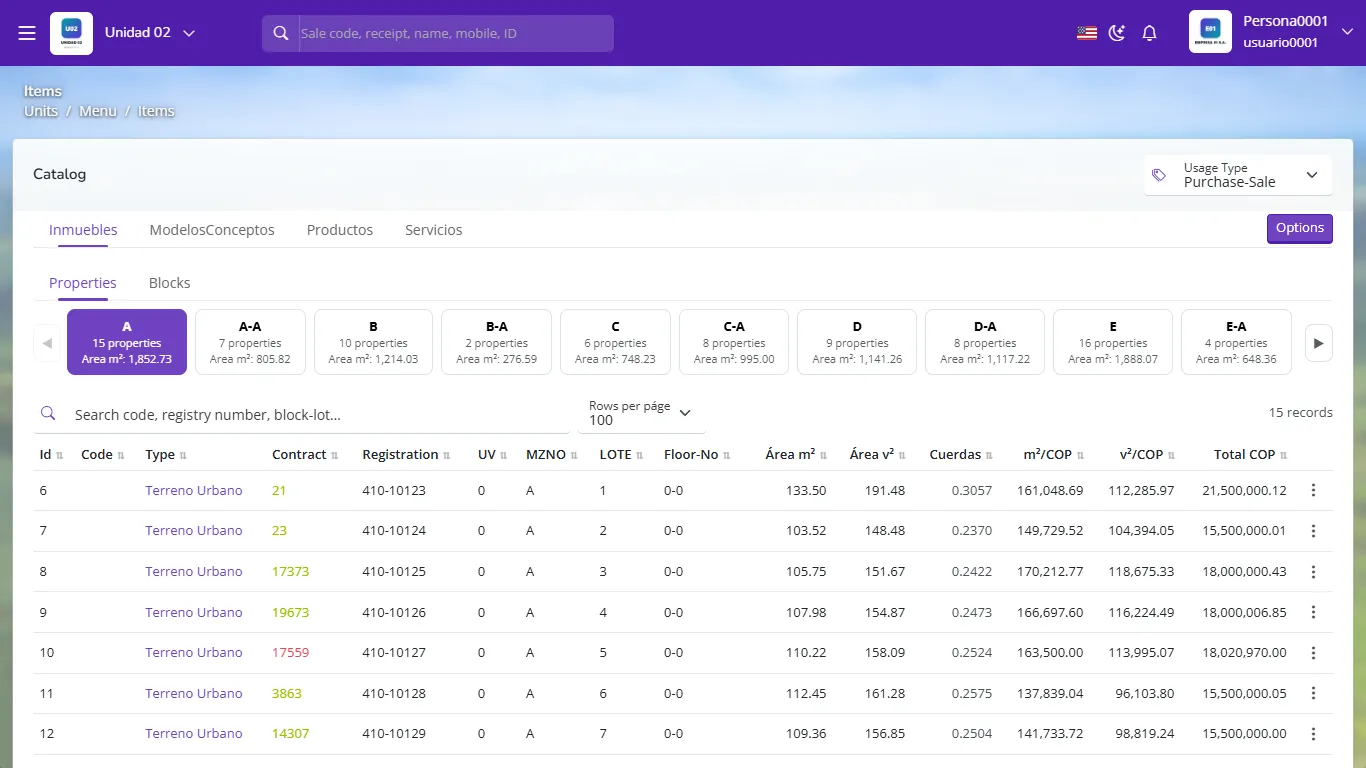
Property inventory by block, with area, price per m² and total Each row is a property: type (urban land, house, apartment), title or registry number, block, lot, area in m², price per m² and total price.
The Contract column shows the sale number if the property is already sold or reserved; the color shows its status.
From Options you can import the inventory from Excel, change prices by block or export the catalog.
In My company → Real estate development you set the project data (type, total area, parent title) and in Geography the plan with the lots.
The total of available properties (no contract) at cost must equal the balance of the Property inventory account. Compare it every month: it is one of the most valuable checks in a real estate company.
- Recording the land as a fixed asset and depreciating it.
- Adding advertising or sales commissions to the cost.
- Not allocating cost to each lot: when it is sold there is no cost of sales and profit is overstated.
A developer buys land to subdivide and sell. What kind of asset is it?
Inventory (IAS 2), not a fixed asset.
A project cost 800,000,000 and has 20,000 saleable m². What is the cost of a 150 m² lot?
800,000,000 / 20,000 = 40,000 per m²; 150 × 40,000 = 6,000,000.
Is the salesperson's commission part of the lot's cost?
No. It is a selling expense and goes to profit or loss.