The accounting equation
The accounting equation Assets = Liabilities + Equity explained with examples: what assets, liabilities and equity are, how revenue and expenses change equity and how every operation keeps the balance.
All of accounting rests on a very simple equality. Once you understand it, you understand why balance sheets always balance.
- Define assets, liabilities and equity with real examples.
- Write the accounting equation and its expanded form with revenue and expenses.
- Analyze any operation and see how it keeps the equation in balance.
The fundamental equality
> Assets = Liabilities + Equity
- Assets: what the company controls and will bring it benefits: cash and bank balances, receivables from customers, inventory of lots or merchandise, machinery, vehicles, buildings.
- Liabilities: what the company owes to third parties: suppliers, banks, taxes payable, wages payable, customer advances.
- Equity: what belongs to the owners: capital contributions plus accumulated profits.
In other words: everything the company has (assets) was financed by someone: by third parties (liabilities) or by the owners (equity).
The expanded equation
Owners gain or lose through results. Revenue increases equity and expenses decrease it:
> Assets = Liabilities + Capital + (Revenue − Expenses)
That is why, at year end, the difference between revenue and expenses (profit or loss) moves into equity. See Closing months and the fiscal year.
Example: the first days of Empresa 01 S.A.
Follow each operation and check that the equality holds (figures in Colombian pesos, COP).
| # | Operation | Assets | Liabilities | Equity |
|---|---|---|---|---|
| 1 | Partners contribute 500,000,000 to the bank | +500,000,000 (bank) | +500,000,000 (capital) | |
| 2 | Buys land for 300,000,000: pays 200,000,000 and owes the rest | +300,000,000 (land) −200,000,000 (bank) | +100,000,000 (loan) | |
| 3 | Sells a lot on credit for 60,000,000 that cost 30,000,000 | +60,000,000 (receivables) −30,000,000 (land) | +60,000,000 (revenue) −30,000,000 (cost) | |
| 4 | Collects the first installment of 5,000,000 | +5,000,000 (bank) −5,000,000 (receivables) | ||
| 5 | Pays wages of 8,000,000 | −8,000,000 (bank) | −8,000,000 (expense) |
At the end:
| Assets | = | Liabilities | + | Equity |
|---|---|---|---|---|
| Bank 297,000,000 + Land 270,000,000 + Receivables 55,000,000 = 622,000,000 | = | 100,000,000 | + | 500,000,000 + 60,000,000 − 30,000,000 − 8,000,000 = 522,000,000 |
622,000,000 = 100,000,000 + 522,000,000. The equality holds after every operation, not just at the end.
Collecting an installment is not revenue: the revenue was already recorded when selling (operation 3). Collecting only swaps one asset (receivables) for another (bank). It is the most common mistake in companies that sell on installments, and GoSoft handles it this way in its real estate module: the sale is booked when the contract is signed and collections settle the receivable. See Module 04.
The four types of change
Every operation fits one of these cases:
- An asset increases and a liability or equity increases (contribution, loan, credit purchase).
- An asset decreases and a liability decreases (paying a supplier).
- One asset increases and another decreases (cash purchase, customer collection).
- One liability increases and another decreases, or movements within equity (refinancing a debt, capitalizing profits).
In GoSoft
The equation shows up in two places you will use constantly:
- The balance sheet (statement of financial position), showing assets, liabilities and equity at a date.
- Accounting health, which checks that assets = liabilities + equity and that every voucher balances.
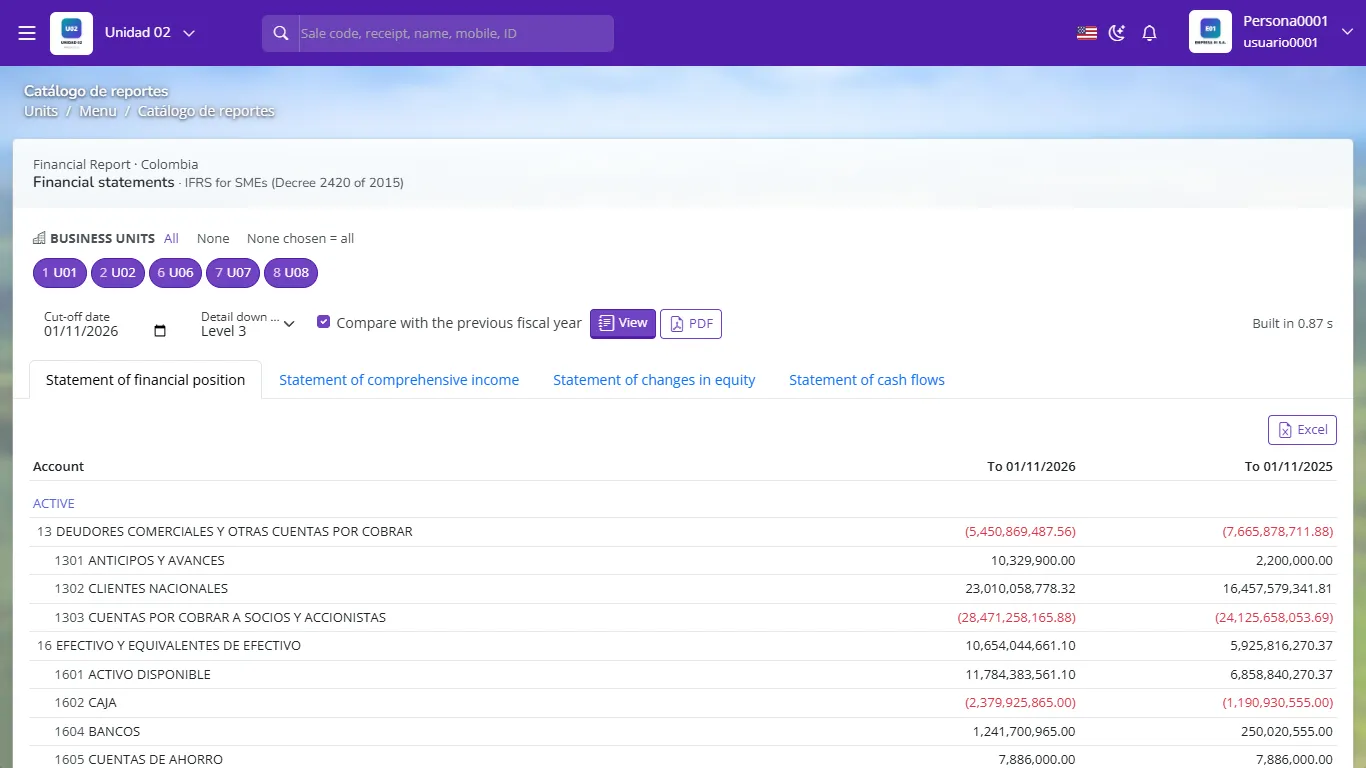
- Recording a bank loan as revenue: it is a liability, it does not increase equity.
- Recording an installment collection as a sale: it doubles the revenue.
- Forgetting that a partner's withdrawal reduces equity; it is not an expense.
Write the expanded accounting equation.
Assets = Liabilities + Capital + (Revenue − Expenses).
The company receives a bank loan of 50,000,000. What changes?
Assets (bank) increase and liabilities (loans payable) increase by 50,000,000. Equity does not change.
Why is collecting an installment not revenue?
Because the revenue was recognized at the sale; the collection only swaps receivables for cash in the bank.
A company has assets of 900 and liabilities of 400. What is its equity?
500, because Equity = Assets − Liabilities.