The four financial statements
The basic financial statements explained: statement of financial position (balance sheet), income statement, statement of changes in equity and statement of cash flows, their names in each country, how they connect and how GoSoft produces them.
Financial statements are the final product of accounting: in a few pages they summarize the company's position and performance. Under IFRS (and almost every framework in the Americas) a complete set has four statements plus notes.
- Explain what each financial statement shows and how they connect.
- Read a statement of financial position and an income statement.
- Produce the statements in GoSoft with your country's official names and compare with the prior year.
The four statements
| Statement | Question it answers | Timing |
|---|---|---|
| Financial position (balance sheet) | What does the company have, owe and is worth? | At a date |
| Income statement (profit or loss) | Did it make or lose money? | Over a period |
| Changes in equity | Why did owners' equity change? | Over a period |
| Cash flows | Where did the money come from and go? | Over a period |
The notes explain accounting policies and detail significant figures.
Balance sheet, statement of financial position, balanço patrimonial (Brazil), estado de posición financiera (Mexico)… When you choose the country, GoSoft uses the official names in its reports and PDFs. Check your country page in Module 12.
Statement of financial position
It presents the accounting equation ordered by liquidity:
| Assets | Liabilities and equity | ||
|---|---|---|---|
| Current assets | Current liabilities | ||
| Cash and banks | 45,000,000 | Accounts payable | 12,000,000 |
| Receivables | 52,000,000 | Taxes payable | 8,000,000 |
| Property inventory | 270,000,000 | Non-current liabilities | |
| Non-current assets | Bank loans | 100,000,000 | |
| Property, plant and equipment (net) | 192,000,000 | Equity | |
| Capital | 400,000,000 | ||
| Profit for the year | 39,000,000 | ||
| Total assets | 559,000,000 | Total liabilities and equity | 559,000,000 |
Current = turns into cash or is paid within the next 12 months.
Income statement
| Item | Amount |
|---|---|
| Sales revenue | 300,000,000 |
| − Cost of sales | (120,000,000) |
| = Gross profit | 180,000,000 |
| − Administrative expenses | (70,000,000) |
| − Selling expenses (commissions, advertising) | (45,000,000) |
| = Operating profit | 65,000,000 |
| + Finance income (installment interest) | 12,000,000 |
| − Finance costs | (18,000,000) |
| = Profit before tax | 59,000,000 |
| − Income tax | (20,000,000) |
| = Net profit | 39,000,000 |
How they connect
- The income statement's net profit moves into equity (statement of changes in equity) and from there to the balance sheet.
- The change in cash and banks on the balance sheet is explained by the cash flow statement.
- So, if one statement does not tie to another, there is an error.
In GoSoft, step by step
Open Financial reports → Financial statements. Choose units, cut-off date, level of detail and whether to compare with the prior year.
Click View. The tabs show the statement of financial position, income statement, changes in equity and cash flows, with the country's names.
gosoft.app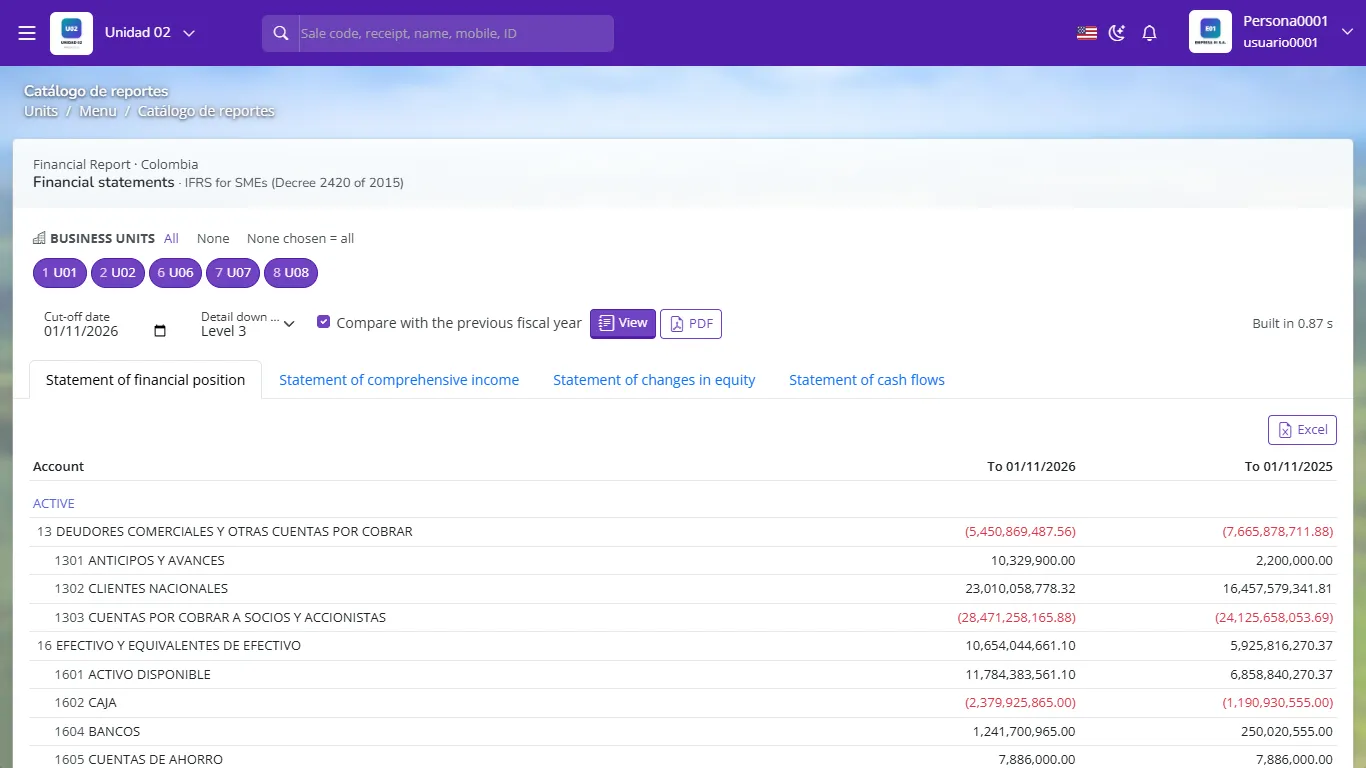
Financial statements compared with the prior year The classic Balance sheet and Income statement reports are also available with more filter options.
gosoft.app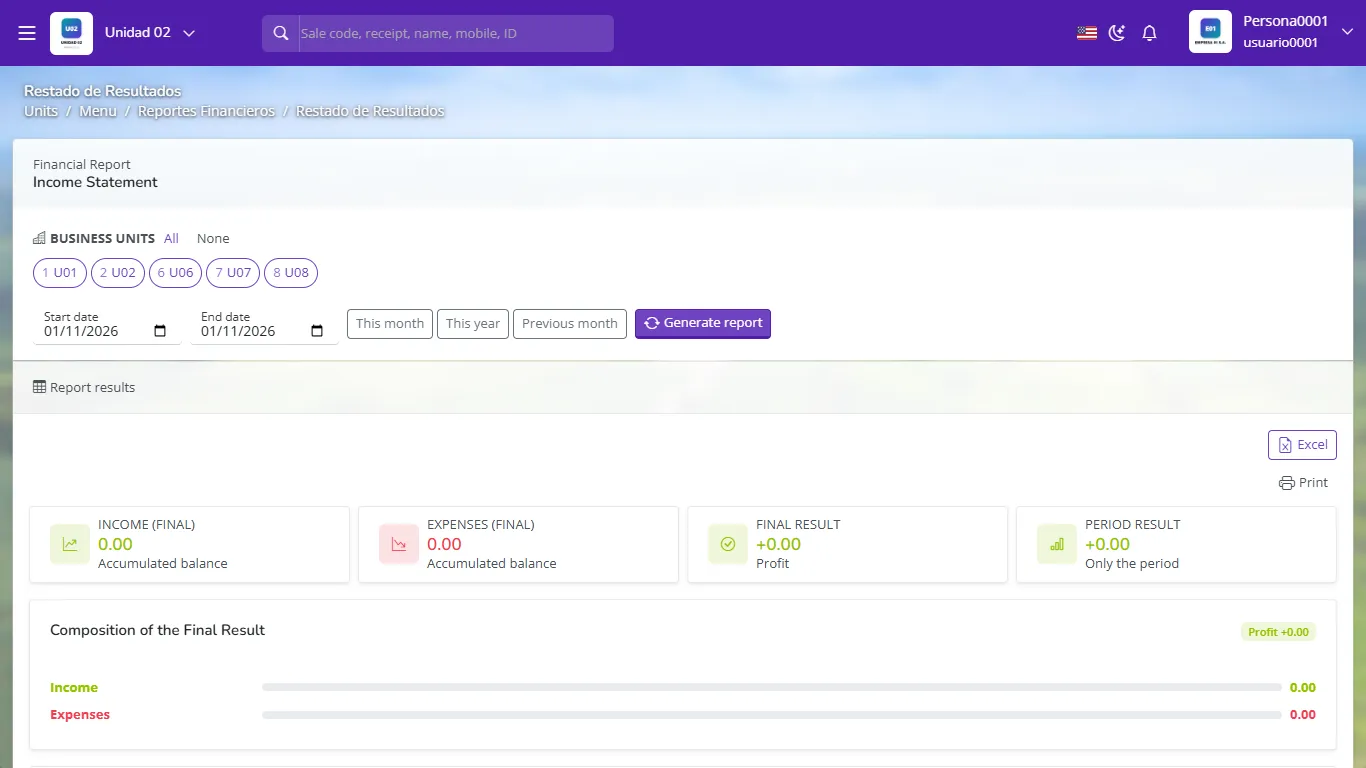
Income statement Download the PDF for signatures (legal representative and accountant) or Excel for analysis.
- Presenting statements without closing the period or making adjustments (depreciation, provisions, FX differences).
- Classifying as current a debt due in three years.
- Delivering statements without notes: readers cannot understand the figures.
Which financial statement is presented at a date rather than for a period?
The statement of financial position (balance sheet).
Revenue 500, cost of sales 300, expenses 120. What is operating profit?
500 − 300 − 120 = 80.
How does the income statement connect with the balance sheet?
Net profit or loss increases or decreases equity on the balance sheet.