Accounts, normal balances and balances
What a ledger account is, the T-account, debit or credit normal balance, how the balance is computed, balance sheet and income statement accounts, memorandum accounts and subsidiary (analytical) detail.
An account is where the movements of a single concept accumulate: everything that comes in and out of the bank, everything customers owe, all the year's sales. The ordered set of accounts is the chart of accounts.
- Use the T-account to follow an account's movements.
- Compute an account's balance and tell whether it is a debit or credit balance.
- Distinguish balance sheet, income statement and analytical accounts.
The T-account
The classic way to draw an account is a T: debits on the left, credits on the right.
| Bank — Debit | Bank — Credit |
|---|---|
| 500,000,000 (contribution) | 200,000,000 (land payment) |
| 5,000,000 (installment collected) | 8,000,000 (wages) |
| 505,000,000 | 208,000,000 |
Balance = 505,000,000 − 208,000,000 = 297,000,000 debit.
Each account's normal balance
The normal balance tells you on which side the balance should end up:
- Debit: assets, expenses and costs.
- Credit: liabilities, equity and revenue.
If Bank ends with a credit balance, more was paid than was available (overdraft) or a receipt is missing. If Accounts receivable ends with a credit balance, the customer overpaid or a collection was recorded without the sale. Checking this is part of accounting health.
Balance sheet and income statement accounts
| Group | Accounts | What happens at closing |
|---|---|---|
| Permanent (balance sheet) | Assets, liabilities and equity | Their balance carries over to next year |
| Temporary (income statement) | Revenue, costs and expenses | Closed against the year's result; start the year at zero |
Control and analytical (subsidiary) accounts
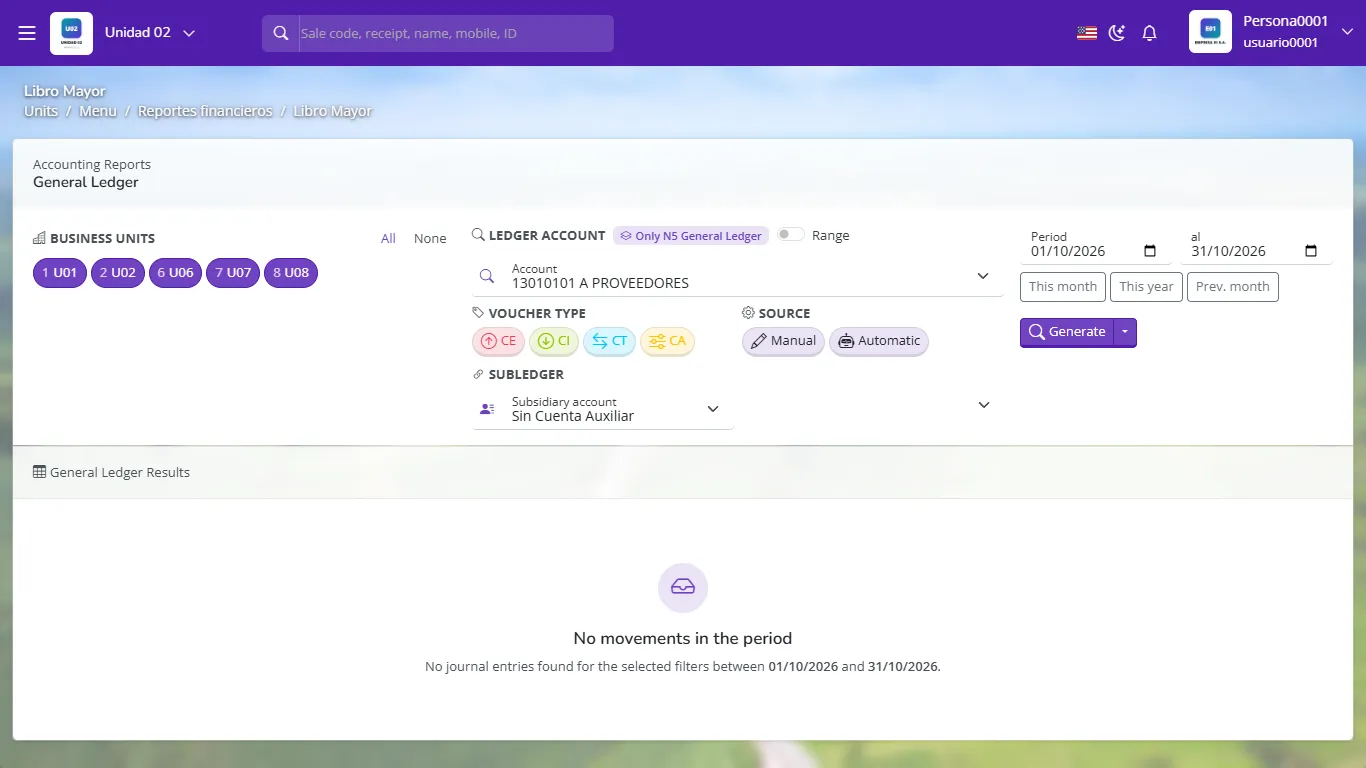
Some accounts group many parties. Accounts receivable has one total, but you need to know how much each customer owes. That is what subsidiary detail is for: each line of the entry carries, besides the account, the party, the property or the document.
In GoSoft each line can carry:
- The person (customer, supplier, employee).
- The cost center (area and sub-area).
- The business unit.
- The source document (sale, receipt, purchase, contract).
So the general ledger can be shown by account and, within the account, by customer or cost center.
Memorandum accounts
They record facts that do not change equity but are worth controlling: guarantees received, goods on consignment, signed contracts not yet effective. They are kept in offsetting pairs (debit and credit control accounts).
- Creating one account per customer in the chart: use subsidiary detail, not thousands of accounts.
- Treating a credit balance in an asset as "normal" without investigating.
- Forgetting to close the income statement accounts at year end.
A bank account has 120 in debits and 150 in credits. What is its balance and what does it mean?
30 credit. For an asset account that is abnormal: it signals an overdraft or a missing record.
Which accounts start every year at zero?
Income statement (temporary) accounts: revenue, costs and expenses.
How do you know what each customer owes if you only have one "Accounts receivable" account?
With subsidiary detail: each line carries the person, and the ledger can be shown by party.