What accounting is and why it matters
What accounting is, what it is for, who uses accounting information, the difference between financial, cost, management and tax accounting, and the basic principles.
Accounting is the information system that records, classifies and summarizes in money the operations of an organization so people can make decisions. It is the language of business: whoever understands it can read a company from the inside.
- Explain in your own words what accounting is and what it is for.
- Identify the users of accounting information and what each one looks for.
- Tell financial, cost, management and tax accounting apart.
- Name the principles behind every accounting record.
What it is for
Picture Empresa 01 S.A., which sells land lots on installments. Things happen every day: a customer pays an installment, materials are bought, a salesperson is paid a commission. Without an orderly record nobody could answer basic questions:
- How much money do we have today in cash and banks?
- How much do customers owe us and how much do we owe suppliers?
- Did we make or lose money this year? On which project?
- How much tax do we have to pay this month?
Accounting answers those questions with verifiable figures, because every number rests on a document (invoice, receipt, contract) and on an orderly record.
Who uses accounting information
| User | What they want to know |
|---|---|
| Owners and partners | Whether the business makes money and what it is worth |
| Management | Where money is made and lost, to decide |
| Banks | Whether the company can repay a loan |
| Tax authority | How much tax is due |
| Suppliers | Whether the company pays on time |
| Employees | Stability and, in some countries, profit sharing |
The branches of accounting
- Financial accounting. Prepares financial statements for external users under common standards (IFRS, US GAAP or local rules). It is the backbone of this course.
- Cost accounting. Calculates what it costs to produce a good or deliver a service: materials, labor and overhead.
- Management accounting. Uses the information to decide: budgets, cost centers, ratios. Covered in Module 10.
- Tax accounting. Applies each country's tax rules: VAT, income tax, withholdings, mandatory books. Covered in Module 09 and in the country pages.
The basic principles
Every accounting framework shares a few fundamental ideas:
- Entity. The company is separate from its owners. A partner's personal car is not a company asset.
- Going concern. The company is assumed to keep operating; that is why assets are recorded at cost and not at fire-sale prices.
- Accrual. Revenue and expenses are recorded when they occur, not when cash is received or paid. If you sell a lot in January and collect it in ten installments, the sale belongs to January.
- Monetary unit. Everything is expressed in a functional currency (dollars, pesos, bolivianos, reais…).
- Periodicity. The life of the company is cut into periods (month, year) to measure results.
- Prudence and reliability. Figures must be verifiable with documents and must not overstate assets or revenue.
Many mistakes come from confusing profit with cash. A company can make money and have no cash (it sold on credit), or have plenty of cash and be losing money (it received a loan). That is why the income statement and the cash flow statement exist separately.
Accounting in a system like GoSoft
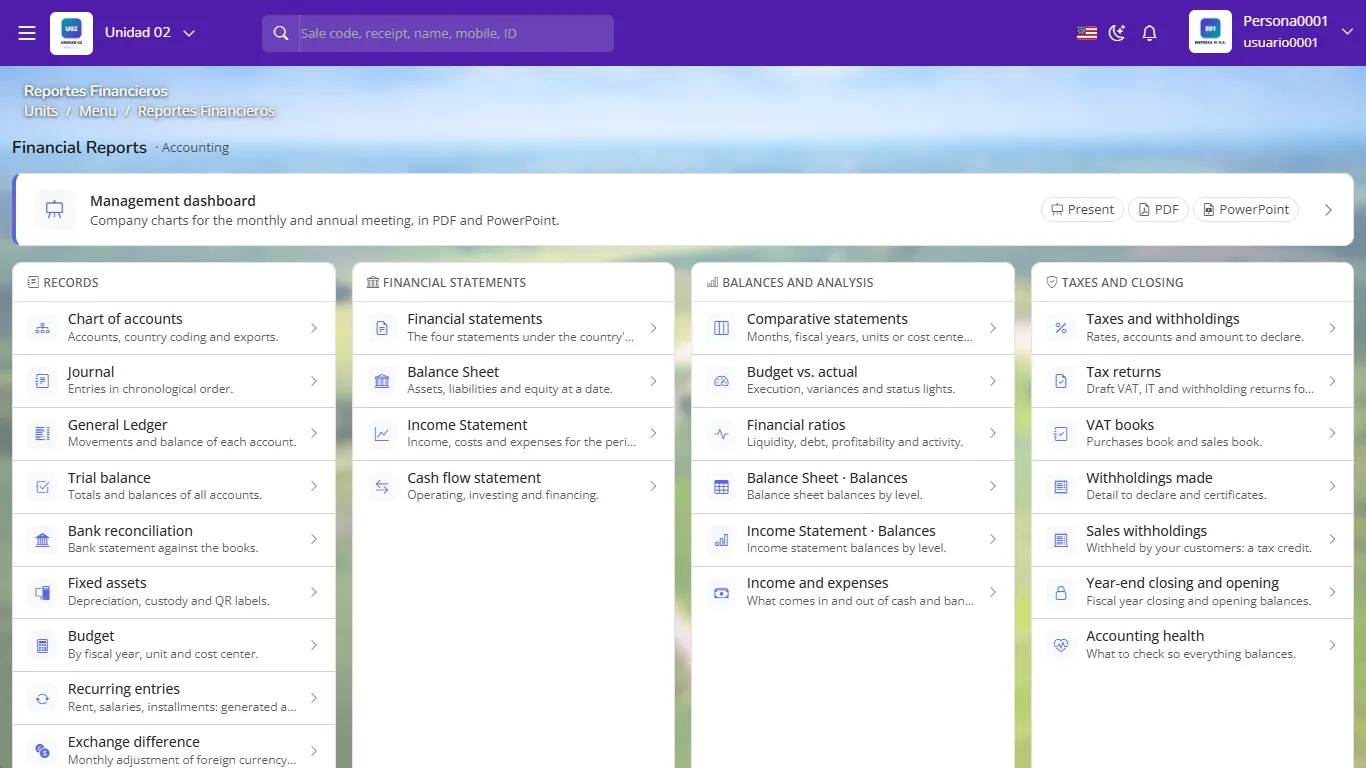
In a modern system accounting is no longer a notebook: it is a database where every operation leaves a voucher with its entry. GoSoft does it in two ways:
- Manual: the accountant records receipt, payment, transfer or adjustment vouchers.
- Automatic: the real estate and trade modules generate the entry when the operation is recorded.
So the books and financial statements are available instantly and always balance, because they are computed from the same vouchers.
- Mixing personal expenses with company expenses (breaks the entity principle).
- Recording the sale only when it is collected (breaks accrual).
- Keeping operations without a supporting document.
What is accounting?
An information system that records, classifies and summarizes in money an organization's operations to support decisions.
You sell a lot in March and collect it in 12 installments. In which month is the revenue under accrual?
In March, when the sale is delivered or signed. The installments are collections of a receivable, not new revenue (except interest).
Which branch of accounting uses budgets and cost centers to decide?
Management accounting.
A partner uses company money to pay his home mortgage. Which principle is broken?
The entity principle: the company and its owners are separate persons.