Accounting standards: IFRS, US GAAP and local rules
What accounting standards are, full IFRS, IFRS for SMEs, US GAAP and local standards across the Americas (Mexican NIF, Brazilian CPC, Argentine RT, Bolivian NC), and how they relate to tax rules.
If every company recorded things its own way, nobody could compare financial statements. Accounting standards are the common rules that say when to record something, for how much and how to present it.
- Explain what an accounting standard is and who issues it.
- Tell full IFRS, IFRS for SMEs and US GAAP apart.
- Know which framework each country in the Americas uses.
- Distinguish an accounting standard from a tax rule.
The main frameworks
| Framework | Issued by | Where it is used |
|---|---|---|
| Full IFRS | IASB, London | Listed companies, banks and large companies in most of Latin America and Canada |
| IFRS for SMEs | IASB | Small and medium-sized entities: a simplified version with fewer options and disclosures |
| US GAAP | FASB, United States | US companies and those listed there |
| Local standards | Each country's professional bodies | Where IFRS was not adopted, or as a complement |
Which framework each country uses (summary)
| Country | Main framework |
|---|---|
| Canada | IFRS for publicly accountable entities; ASPE for private enterprises |
| United States | US GAAP |
| Mexico | NIF, issued by CINIF (very close to IFRS) |
| Colombia | IFRS by groups: full (group 1), SMEs (group 2) and simplified accounting (group 3) |
| Peru, Chile, Ecuador, Uruguay, Paraguay, Central America | Full IFRS or IFRS for SMEs |
| Brazil | CPC pronouncements, converged with IFRS |
| Argentina | FACPCE technical resolutions; IFRS mandatory for listed companies |
| Bolivia | CTNAC accounting standards; IFRS as a supplementary source |
Each page in Module 12 explains the country's framework in more detail.
Accounting standards and tax rules are not the same
The accounting standard aims to show economic reality. The tax rule aims to compute the tax. Sometimes they agree and sometimes they do not:
- A fine is an accounting expense but is almost never deductible for income tax.
- An asset's useful life may differ for accounting and for tax.
- Some countries require their own books and formats (for example, VAT purchase and sales books).
That is why the accountant keeps the books under the accounting standard and then reconciles with tax. Under IFRS, the differences give rise to deferred taxes.
Under IFRS 15 (revenue from contracts with customers), revenue from the sale is recognized when control of the property transfers, and the financing interest is recognized as it accrues. GoSoft follows that logic: it books the principal sale when the contract is signed and each installment's interest when it is collected. See Collecting installments, arrears and interest.
Standards in GoSoft
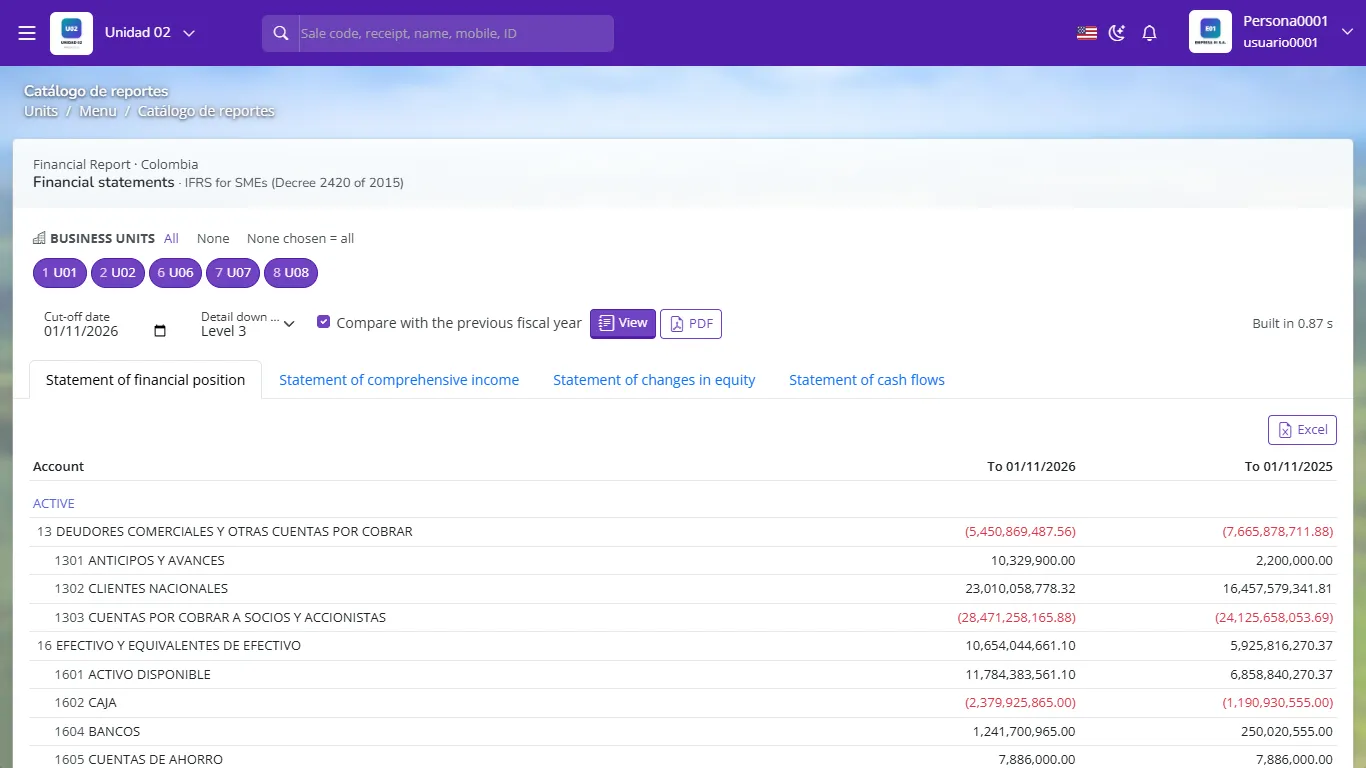
When you choose the company's country, GoSoft loads its accounting profile: chart of accounts coding, official names of the financial statements, reference taxes and withholdings, and periodic returns.
- Keeping the books "only for taxes" and ignoring economic reality.
- Applying full IFRS to a micro-business that could use IFRS for SMEs or a simplified regime.
- Copying another country's chart of accounts without adapting the coding or taxes.
Who issues IFRS?
The IASB (International Accounting Standards Board).
Which framework do US companies use?
US GAAP, issued by the FASB.
Why can a fine be an accounting expense but not tax-deductible?
Because accounting reflects economic reality while tax law decides what counts for the tax computation; fines are usually excluded.
What does GoSoft load when you choose the company's country?
Its accounting profile: chart of accounts coding, statement names, reference taxes and withholdings, and tax returns.