Foreign exchange differences
What foreign exchange differences are (IAS 21), how monetary items in foreign currency are remeasured at closing, computing FX gains and losses with examples and how GoSoft generates the monthly entry.
If your company holds dollars in the bank, customers who owe you in dollars or a loan in dollars, their value in your currency changes every day with the exchange rate. The FX difference is the gain or loss from remeasuring those items at the closing rate.
- Tell monetary and non-monetary items apart.
- Compute the FX difference on a foreign-currency asset and liability.
- Generate the monthly entry in GoSoft.
Monetary and non-monetary
| Type | Examples | Remeasured at closing? |
|---|---|---|
| Monetary | Cash and bank in dollars, receivables and payables in dollars, dollar loans | Yes, at the closing rate |
| Non-monetary | Inventory, fixed assets, advances received or paid | No: they stay at the historical rate |
Rule (IAS 21 / ASC 830)
- The transaction is recorded at the spot rate of the day.
- At each period end, monetary items are remeasured at the closing rate.
- The difference goes to profit or loss (finance income or expense).
Example: Empresa 01 S.A. (functional currency COP)
| Item | USD | Historical rate | Book value | Closing rate | Value at closing | Difference |
|---|---|---|---|---|---|---|
| Dollar bank account (asset) | 10,000 | 4,000 | 40,000,000 | 4,150 | 41,500,000 | +1,500,000 gain |
| Dollar loan (liability) | 20,000 | 4,000 | 80,000,000 | 4,150 | 83,000,000 | −3,000,000 loss |
If the dollar rises, you gain on what you hold in dollars and lose on what you owe.
| Account | Debit | Credit |
|---|---|---|
| Bank · USD account | 1,500,000.00 | |
| Finance income · FX gain | 1,500,000.00 | |
| Finance expense · FX loss | 3,000,000.00 | |
| Bank loans in USD | 3,000,000.00 | |
| Equal totals | 4,500,000.00 | 4,500,000.00 |
The closing difference is unrealized: if the dollar falls next month, it partly reverses. When you collect or pay, the final difference becomes realized. Both go to profit or loss; some countries require reporting them separately in the income tax return.
In GoSoft, step by step
Open Financial reports → FX differences.
gosoft.app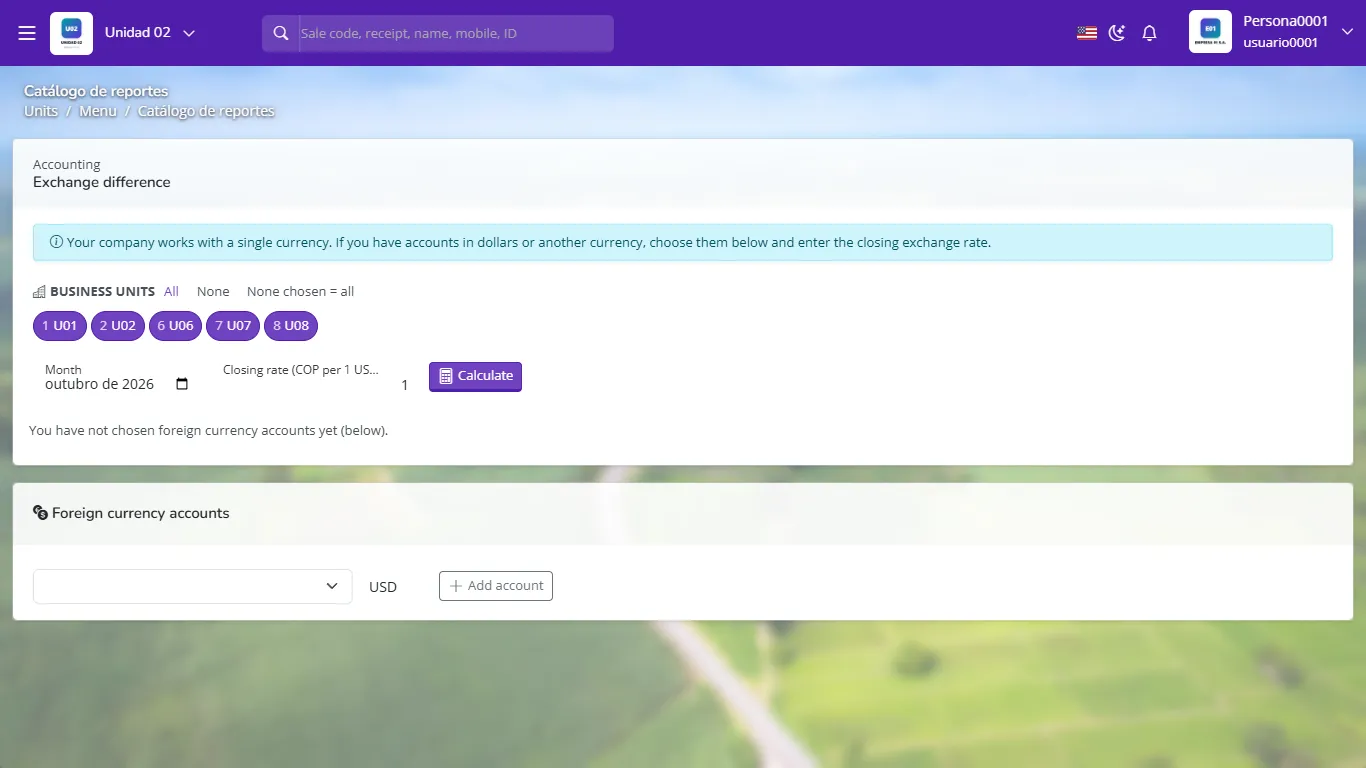
FX differences: foreign currency accounts and closing rate Under Foreign currency accounts add the monetary accounts you keep in another currency (banks, customers, suppliers, loans) and set their currency.
Choose the month and type the closing rate. Click Calculate: GoSoft shows, by account, the foreign currency balance, book value, value at closing and the difference.
Confirm to generate the FX difference voucher. GoSoft uses the FX gain and loss accounts (and creates them if missing).
Repeat every month. If the company works in a single currency, the screen says so and this step is not needed.
- Remeasuring inventory or fixed assets (they are non-monetary).
- Using any bank's buy or sell rate instead of the official one your country requires.
- Forgetting to remeasure foreign currency loans.
Is inventory bought in dollars remeasured?
No. It is non-monetary and stays at the historical rate.
You owe USD 5,000 booked at 4,000 and the closing rate is 3,900. Gain or loss, and how much?
A gain of 500,000: the debt falls from 20,000,000 to 19,500,000.
Where does the FX difference go?
To profit or loss, as finance income or expense.